

Autism, Art, and the Guilt of Feeling Fully Alive
Rethinking Productivity, Procrastination, and the Value of Making Things

The Lesson We Were Taught About “Real Work”
Somewhere along the line, many of us learned — explicitly or implicitly — that productivity only counts if it looks like conventional labor.
A job. A paycheck. A measurable output.
Something you can point to and say, “See? That was work.” Art doesn’t always look like that from the outside. But from the inside, it can be the most demanding, focused, and emotionally expensive work we do.
So two narratives begin to collide.
Narrative A — Internal, Authentic:
This is what I’m built to do. My whole nervous system lights up. I’m calmer, clearer, more alive when I’m making art.
Narrative B — External, Inherited:
Real work is jobs, money, applications, and visible results. Art is indulgent unless it’s already profitable. When those two narratives run simultaneously, guilt arises. Not because art is wrong — but because we are stepping outside the script we were handed.
Conditioning of “Respectable Work”
Many of us were trained in environments where value was tied to credentials, publications, institutions, and validation from authority figures.
Art is different.
Art is self-authorized.
There is no committee. No rubric. No permission slip.
And that freedom can feel suspicious at first.
When no one is grading you, the internal critic steps in and says,“This can’t possibly count.”
Financial Pressure and Survival Logic
When money is tight, the brain defaults to survival mode: If this isn’t directly producing income right now, it’s irresponsible.
On the surface, that sounds logical. But it ignores something essential: For some of us, art is not leisure. It is infrastructure.
When we create, our mood stabilizes. Clarity returns. Motivation rises. Ideas for income actually appear.
Without it, we spiral, stall, or burn out.
Paradoxically, not making art is often what hurts productivity.
Art as Regulation, Not Recreation
For many neurodivergent creators — especially autistic adults — art is not a hobby. It is regulation. It functions like meditation, therapy, cognition, and expression all at once.
It organizes the mind. It releases tension. It restores coherence.
Suppressing that impulse is not neutral.
It’s like telling a runner they’re lazy for jogging, when jogging is how their mind stays functional.
Cultural Messaging and Invisible Labor
Western culture often glorifies visible busyness and undervalues invisible creation.
Filling out forms looks responsible. Sketching for two hours looks like avoidance. But the reality is often the opposite.
One drains energy.
The other generates it.
The world sees the form submission. It doesn’t see the mental clarity that came from drawing beforehand.
A Different Definition of Productivity
Instead of asking, “Shouldn’t I be doing something productive?” There is another question worth asking: What keeps me capable?
For some people, it’s exercise.
For others, it’s journaling.
For others, it’s prayer, meditation, or music.
For many of us, it is art.
Art is not dessert.
It is oxygen.
The guilt does not arise from doing something wrong. It arises because we are rewriting our definition of work in real time — and the nervous system takes repetition before it believes a new truth.
Over time, the guilt loosens. Permission replaces it. Then identity follows.
Not: I feel bad for drawing.
But:
This is part of how I stay capable.
Micro-Story
I remember an art professor once saying something that startled the entire room “This class will be the most difficult thing you do all day.”
He wasn’t exaggerating. He was correcting a misconception.
Many people assume art is frivolous — a pleasant diversion, a hobby, a break from “real work.” But what he was pointing out was the opposite: art demands an intensity of attention most people rarely practice.
In drawing, you are not simply moving a pencil. You are making decisions every second.
What line goes here?
How dark should this be?
Am I drawing what I think I see, or what is actually in front of me?
Every mark carries a consequence. Every choice reflects judgment. And even after finishing, the mind keeps working — questioning alternatives, reconsidering structure, asking why this image needed to exist in the first place.
Art is not the absence of work. It is concentrated awareness.
A line from a Talking Heads song has been echoing in my mind lately — the suggestion that if your work isn’t something you love, something is off. I used to think that was idealistic. Now I’m not sure.
Cultural Messaging: “Art Is for Later”
There’s a commercial I remember seeing repeatedly — and during the Super Bowl — that left me with mixed feelings.
It shows a large room filled with retirees painting. They’re smiling, relaxed, dipping brushes into bright colors, decorating bowling balls, standing at easels, laughing together. On the surface, it’s wonderful. It celebrates creativity. It shows older adults engaged and expressive.
And yet, something about it unsettled me.
The message beneath the imagery seemed to suggest that art is something you arrive at after your “real life” is complete. As if creativity belongs to the golden years — the period when you finally have time, when the pressure is off, when work is done, and responsibility fades.
I absolutely support people making art at any age.
I love seeing seniors create.
But the narrative implied something subtle and powerful: Art is a hobby you earn after productivity. Art is relaxation, not identity.
That message reinforces a cultural script many of us absorb without noticing — that creativity is optional, decorative, and safely postponed until retirement. It implies that the joy of making something should wait until life is quieter, instead of being allowed to exist at the center of who we are.
The problem is not the painting.
The problem is the postponement.
For some of us, art is not a pastime waiting at the end of life. It is a way of thinking, regulating, and understanding the world now.
A Forward Glance
I don’t expect life to magically rearrange itself around art.
Balance matters. Bills exist. Responsibilities are real.
But I also know that postponing creativity entirely is not sustainable for me. The ideal might be a dedicated studio and six or more uninterrupted hours a day — the kind of space where ideas can expand without constraint. That vision is motivating, but it’s also not my present reality.
What is realistic is rejecting the idea that art belongs only at the edges of life.
Even an hour.
Even a sketch.
Even a small act of making.
The point is not perfection or total immersion.
The point is continuity.
Art does not have to wait for retirement, for financial security, or for a mythical stretch of free time. It can exist now — imperfectly, intermittently, but authentically.
For some of us, creating is not an escape from life.
It is part of how we remain fully present within it.
Practice, Not Theory
This belief in art as something lived — not postponed — is also why I created MicroGenesis Academy, a small set of digital courses designed for people who want to begin drawing from scratch or rediscover it after years away.
The focus is not on talent or perfection.
It’s on decisions.
Rule-based drawing is a gentle framework that helps people notice composition, line weight, texture, balance, and contrast without intimidation. Instead of asking, “Am I good at art?” the question becomes, “What choice do I want to make next?”
The goal is not mastery.
It is permission — and continuity.
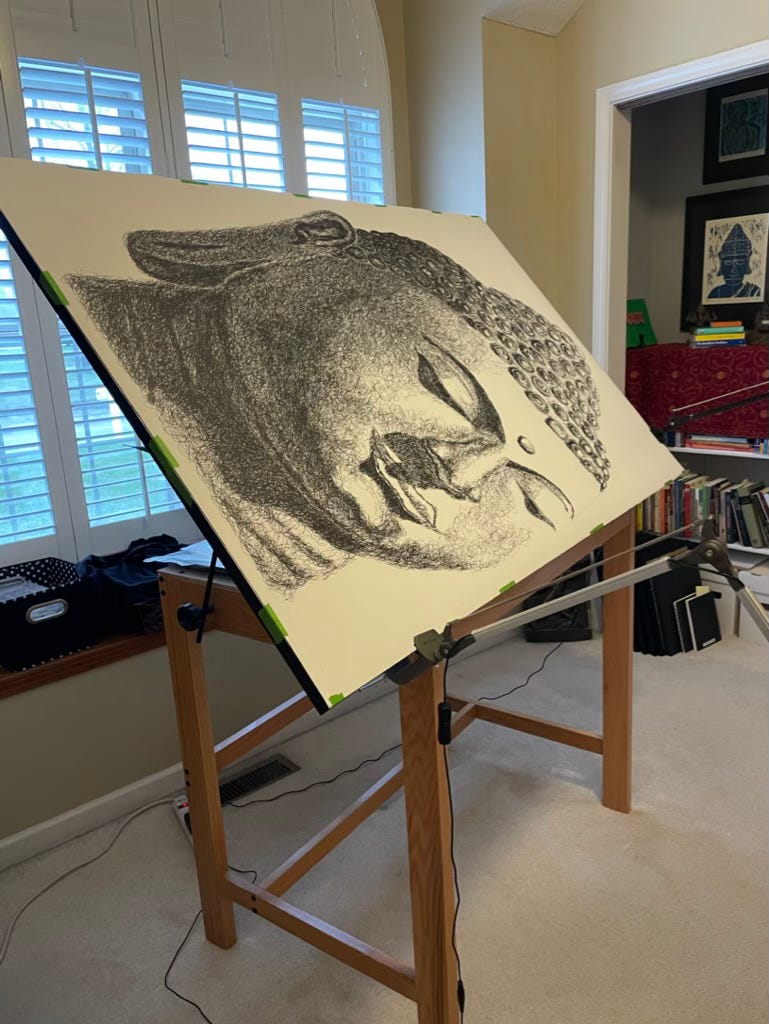
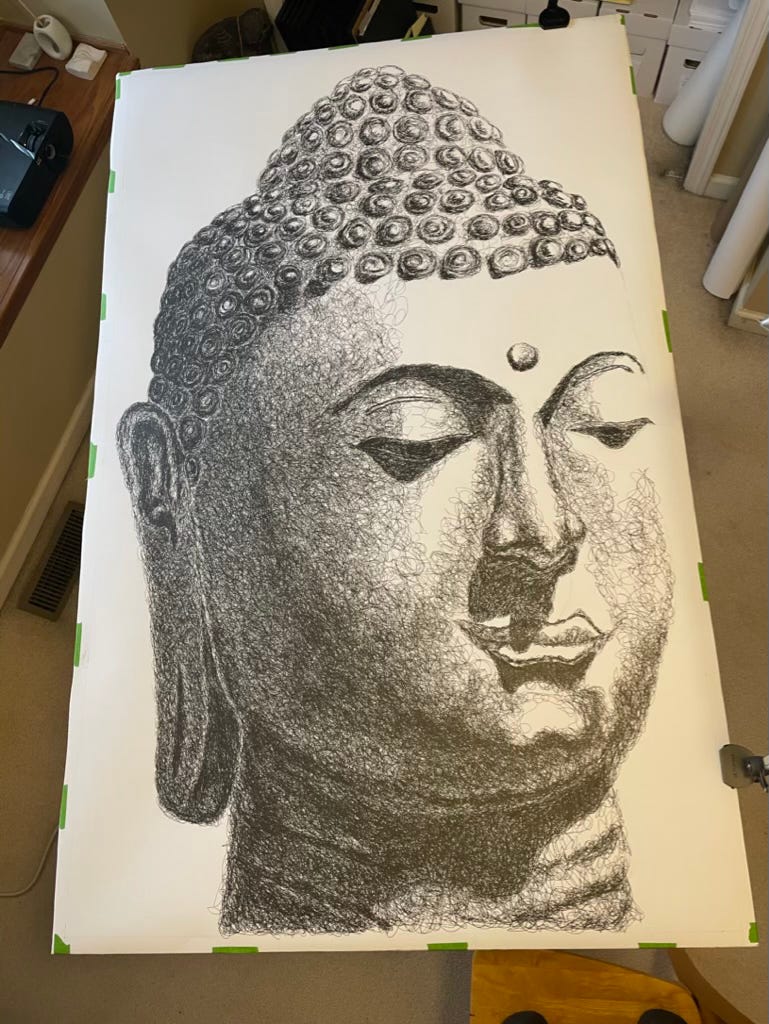
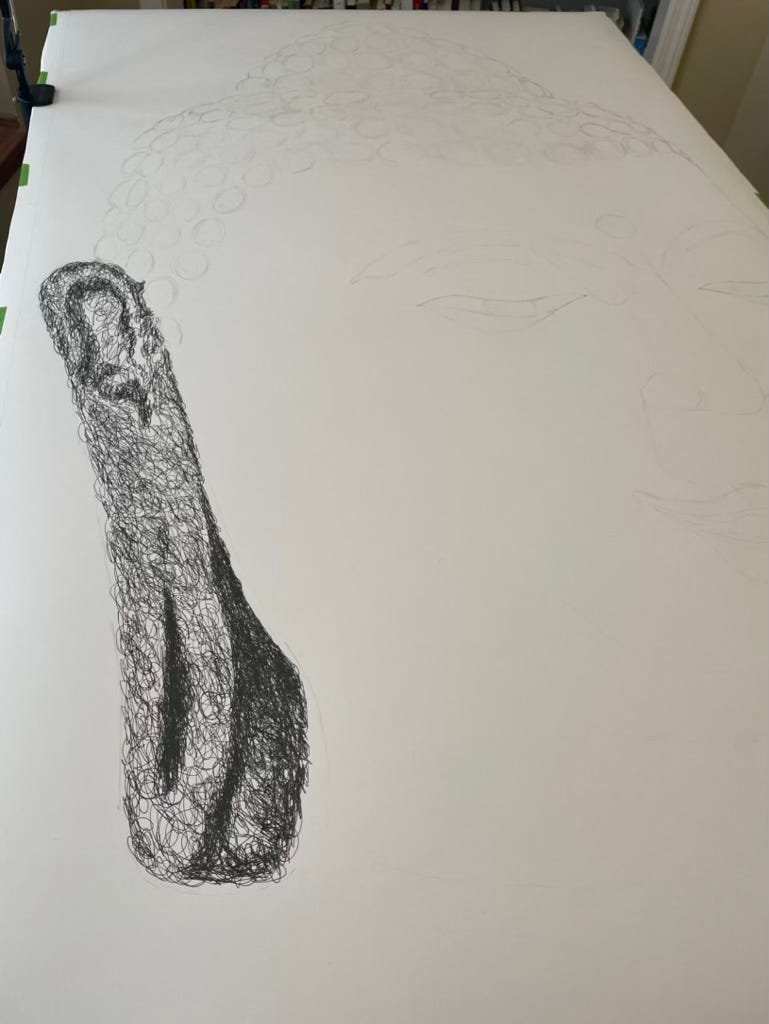
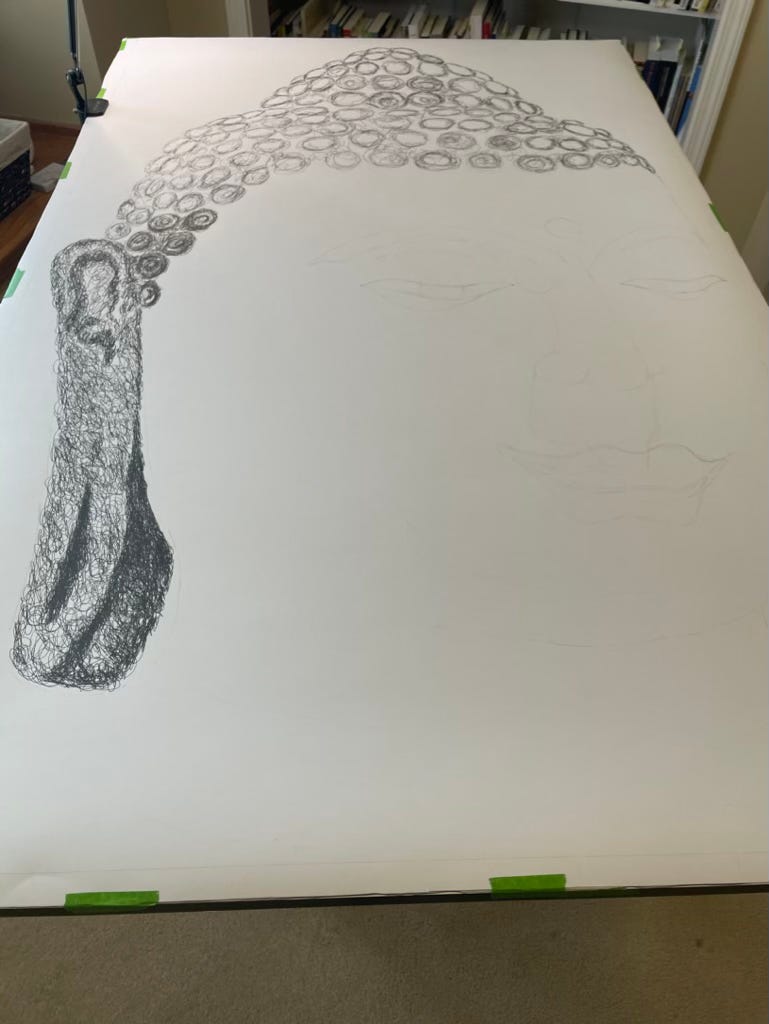
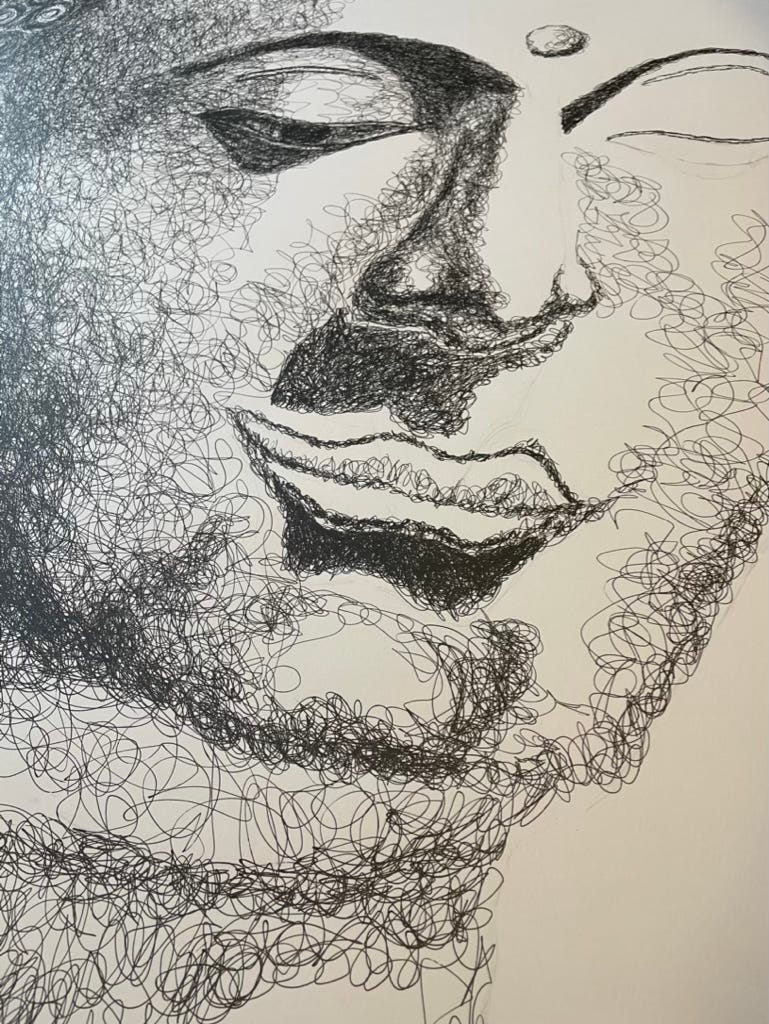
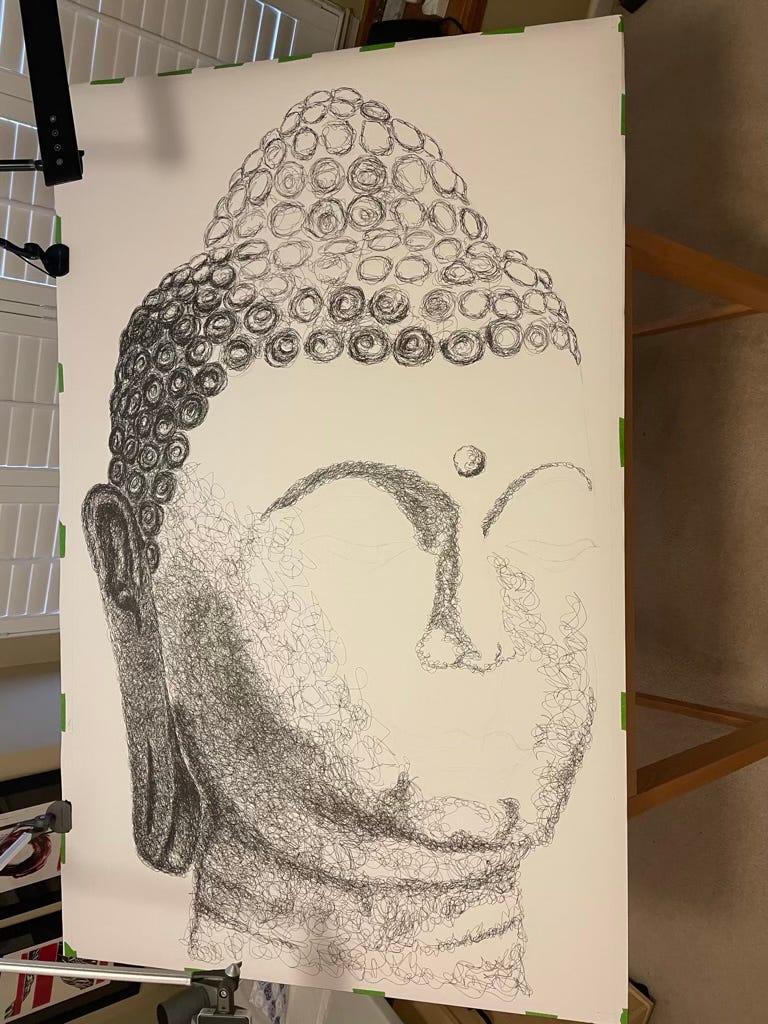
(Note: “Scribble Buddha” is currently in a custom-made frame, not permanently attached to the drafting table. Yes, the word choice was intentional!)
—
Jeff Brackett
Artist | Writer | Educator
Exploring the intersections of art, autism, and human connection through the ongoing creative project Lines on the Spectrum — an illustrated memoir in progress.
https://www.jeffreymbrackett.com/
Aspie Art Journey — reflections on art, perception, and creative process.
Dating App Diaries — essays on vulnerability, connection, and rediscovery.
Thanks for reading Aspie Art Journey! Subscribe for free to receive new posts and support my work.