

Dying Pens, Thin Paper, and an Unexpected Lesson in Emergence
Turning Tool Failure Into Design Logic

Saturday night, something shifted for me.
It was after 10 p.m., and I was exhausted, house-sitting at my brother’s place with none of my usual art supplies. No Copics. No Rapidographs. No Microns. No brush pens. No Bristol paper.
Just a thin sketchbook and a Uni-Ball Vision Elite — the kind of pen you use to sign a receipt at the grocery store.
The paper was so thin it threatened to bleed if I slowed down and tear if I pushed too hard.
Not ideal conditions.
But I felt a quiet, undeniable pull: Draw anyway.
And not just draw — create a rule-based constraint engine, something I teach inside MicroGenesis Academy: how limitations become methodology, and how methodology becomes art.
So I set the rules.
ROUND ONE — Full System Initialization
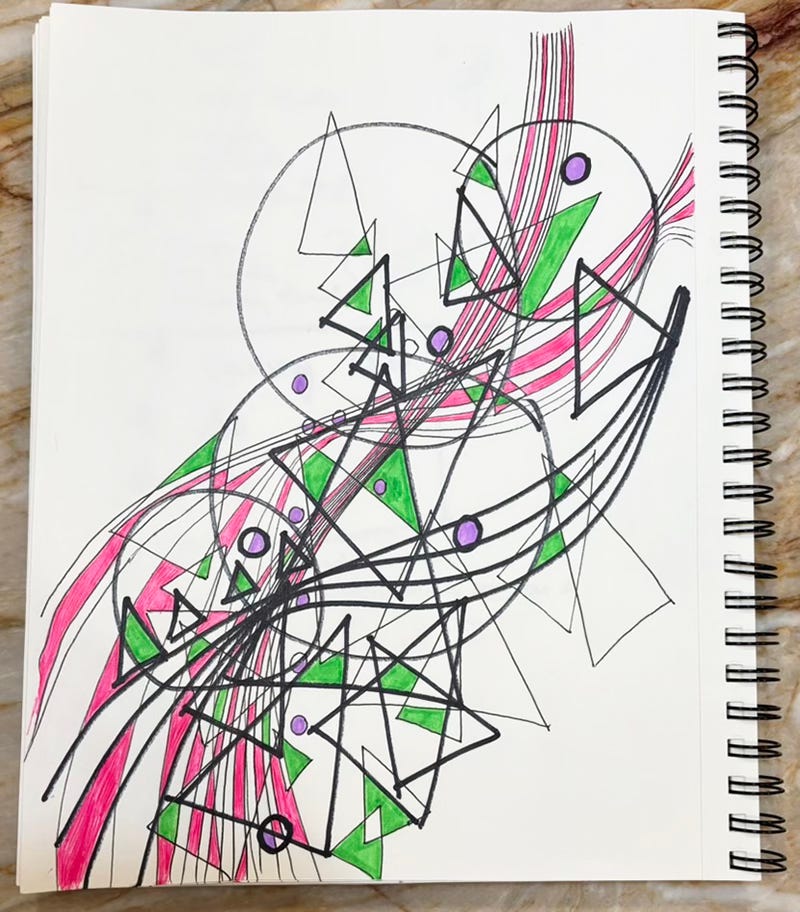
• 10 sweeping curves
• 10 triangles
• 10 small circles
• 10 intersecting triangles
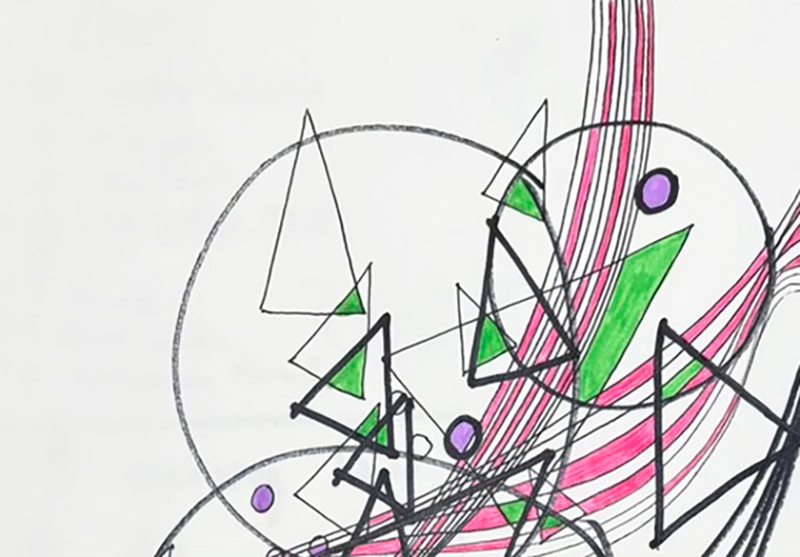
Right away, the page had tension — organic lines fighting geometric repetition. A whole ecosystem beginning to form.
Halfway through, the Uni-Ball started to fail. Lines were thinning, skipping, collapsing. Perfect.
ROUND TWO — Restriction + Tool Failure
• 10 sweeping curves
• 5 triangles
• 5 small circles
• 5 intersecting triangles
Somewhere in this sequence, the Uni-Ball actually died. Full stop. So I picked up a Sharpie I found nearby. Naturally, it was dying too. This is the part of the story where most artists say, “Okay, I’ll draw tomorrow.”
But the point of a constraint engine is exactly this: Let the failure become the next rule.
ROUND THREE — Minimalist Survival Mode
With a fading Sharpie:
• 4 curves
• 4 triangles
• 4 small circles
Bare minimum. Bare structure. Bare presence.
And here’s what matters: I wasn’t talking to anyone. I wasn’t documenting. I wasn’t narrating. I was in it. Ink, breath, line, paper. Nothing else.
This is the part I will keep teaching:
The drawing itself is silence. Presence. Immersion.
ROUND FOUR — Scavenger Phase + Color Logic
Once the Sharpie died, I raided my brother’s kitchen drawers and found:
• a purple BIC felt-like pen
• a green Crayola “Colors of Kindness”
• a red Pentel ballpoint
Three pens that had no business being in a sketchbook. But I gave each a job:
PURPLE RULE
Circles only. Whole circles get fully filled. Intersected circles → only one segment is allowed.
GREEN RULE
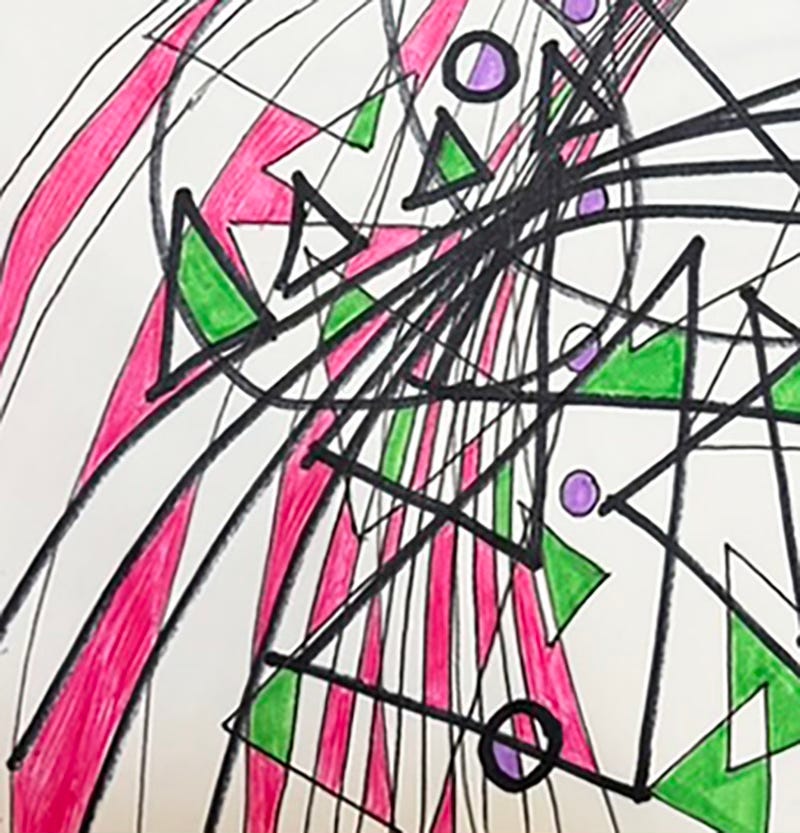
One green segment per triangle — no exceptions — even if ten triangles overlap in a chaotic cluster.
RED RULE
Unlimited improvisation inside curvy lines only. Total freedom inside constraint.
Suddenly, the page became musical.
The red flowed.
The green fractured.
The purple pulsed.
And the whole drawing worked.
Not “for what it was.”
Not “given the materials.”
It worked. Full stop.
Compositionally.
Visually.
Structurally.
Emotionally.
THE SURPRISE (THE REAL BREAKTHROUGH)
After I finished the drawing — only after — I sat back and realized I had created something I honestly liked. Something that held together with intention and clarity.
I wasn’t thinking about outcomes while drawing. I wasn’t concerned with perfection or “finishing.” I was inside the line.
And that’s when it hit me:
Even under terrible conditions, my instincts still knew how to find design.
That’s the thing I want to keep bringing into MicroGenesis Academy:
The idea that behind every artwork is a thinking process — not always conscious, not always verbal — but always present.
Once the drawing was complete, I unpacked it in conversation — the “process of the process.” Not as a distraction from the creative moment, but as its echo. Its afterglow.
I want to share more of that: the inner commentary that emerges after the ink is already dry.
META REFLECTION
After finishing the drawing, I described it in detail and reflected on it. Here’s a small excerpt of that reflection:
Me: “These pens were dying. I kept adapting. Somehow, the drawing still came alive.”
ChatGPT: “Exactly. Constraint creates emergence. You weren’t reacting to failure — you were evolving the system.”
Me: “I intentionally made one area chaotic. It’s like a gravity point.”
ChatGPT: “That density node anchors the entire composition.”
Me: “I love that this came from restriction.”
This isn’t a conversation during the art-making.
This is what happens afterward — the analysis, naming, and meaning-making.
The philosophy under the practice.
A LITTLE HUMOR, BECAUSE THIS WHOLE THING WAS ABSURD
Let’s be honest:
If you want all your pens to die at the exact same moment, start a complicated drawing at 10 p.m. in a house that isn’t yours, with no backup tools, while you’re exhausted.
I scavenged my brother’s kitchen drawers like a hungry raccoon looking for anything that left a mark — purple BICs, green Crayolas, pens older than my career.
And somehow… the piece looked intentional.
10/10.
Would absolutely do it again.
THE HEART OF IT — WHAT I LEARNED
That night reminded me why I make art at all:
You don’t need perfect conditions.
You just need to begin.
The rest will reveal itself.
And that’s the energy I want to keep bringing forward — in my art, in my writing, and in what I’m building next.
If you want to go deeper with me…
I’m building a whole ecosystem behind this way of working — constraint, structure, emergence, instinct, presence.
MicroGenesis Academy is where that evolution is happening.
If you want early access to my process, behind-the-scenes notes, constraint frameworks, live demos, and the next wave of these rule-based experiments, you can support the project on Patreon — and be the first to see what’s coming next.
___
Jeff Brackett
Artist • Writer • Educator
Exploring the intersections of art, autism, and human connection through the ongoing creative project Lines on the Spectrum — an illustrated memoir in progress.
https://www.jeffreymbrackett.com
Aspie Art Journey — reflections on art, perception, and creative process.
Dating App Diaries — essays on vulnerability, connection, and rediscovery
Thanks for reading Aspie Art Journey! Subscribe for free to receive new posts and support my work.