

My Intuition Is Architectural: On Art, Asperger’s, and Naming What Was Always There

Preface: The Core
This blog has always been the journey of the Aspie artist.
Over time, I’ve written about relationships, perception, diagnosis, social friction, and the strange mechanics of connection. The themes have varied. The lens has not.
The lens is structural.
The art is not a side thread. It is how the structure becomes visible.
If there is a shift here, it is not in direction but in clarity. I’m beginning to name what has always been operating beneath the surface.
This is not just about a drawing.
It’s about how my mind builds structure — and how that structure shapes everything else.
Every Element Works
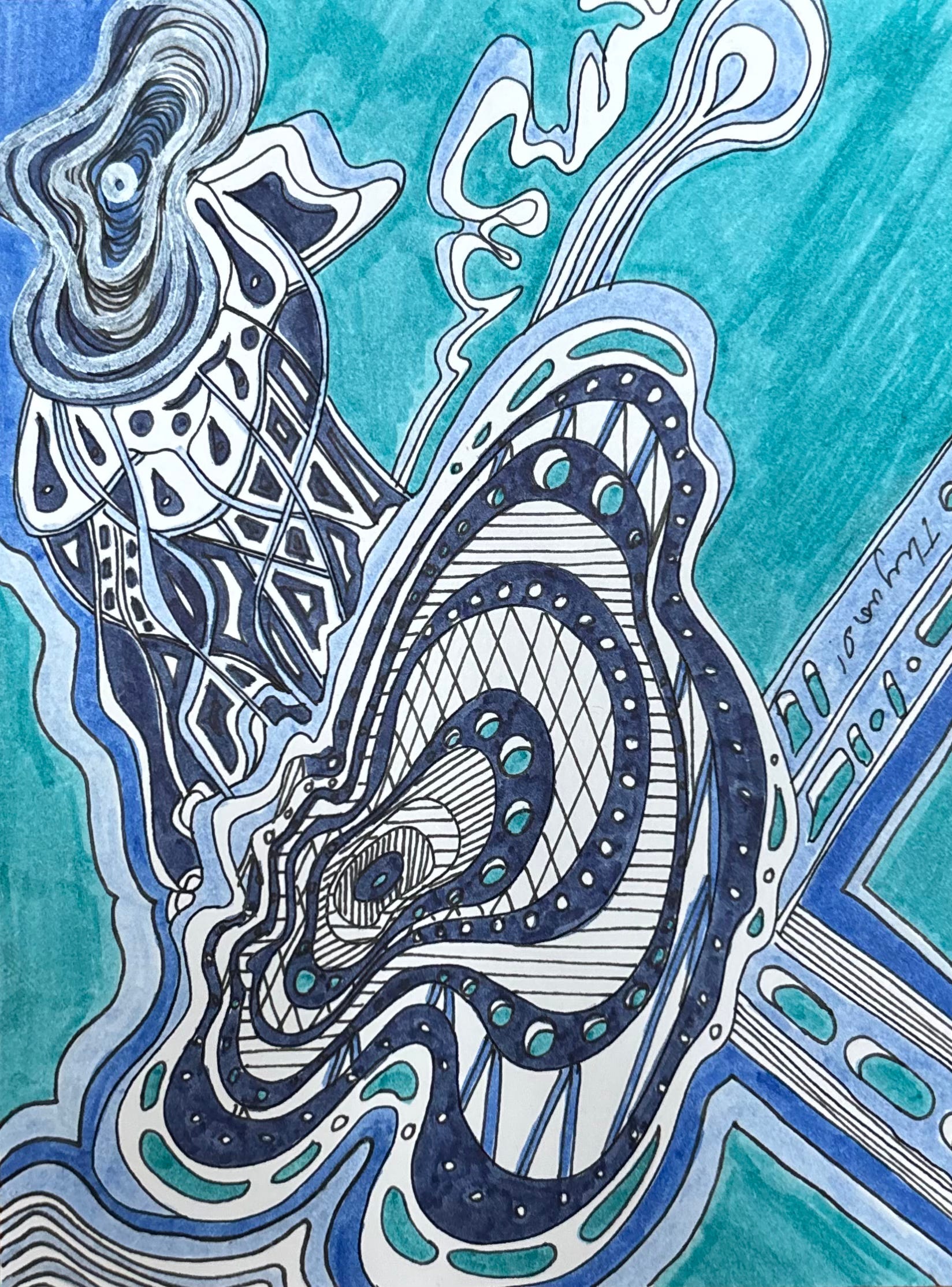
Late into the evening, I stepped back from the drawing and thought: Every element works.
Not, “I’m proud of this.”
Not, “This makes me feel something.”
Not even, “I’m happy.”
It felt more like an internal audit.
The deep blue core held its gravitational pull. The teal field pushed the form forward without flattening it. The cross-hatching deepened the central tunnel without muddying the whites. The negative space stayed intentional.
The curve-to-angle transitions created tension without chaos. Nothing floated. Nothing sagged. Nothing was decorative. It passed.
And then — the only unfiltered sentence of the night — I said out loud:
It’s fucking good.
That wasn’t spectacle. It was confirmation.
Intuition as Architecture
We often separate intuition from design — as if intuition is emotional and spontaneous, while architecture is calculated and imposed.
In my experience, they are not opposites.
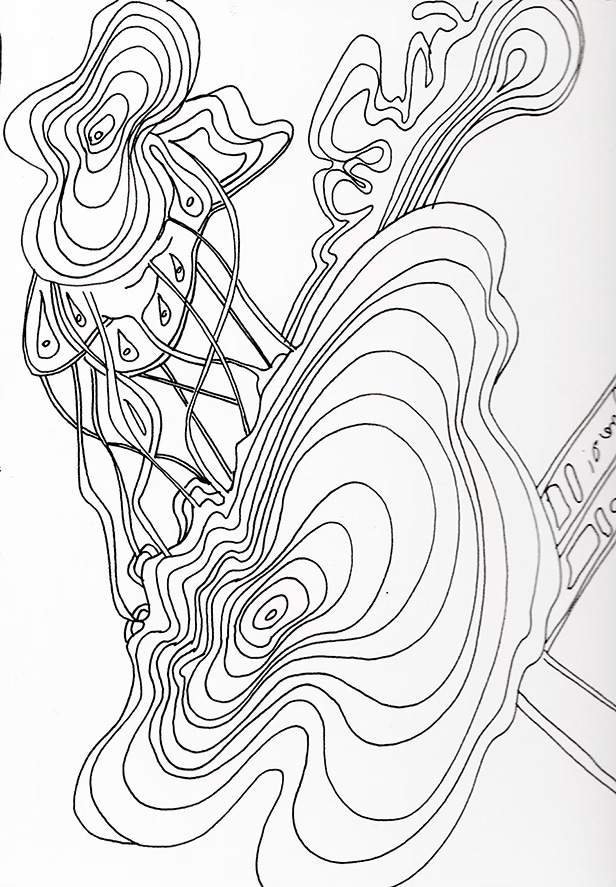
When I put down a line, I respond to it. But the response isn’t random. The system that organizes the page is the same system that organizes how I think. It automatically seeks counterweight, density shifts, anchoring, tension, resolution.
My intuition integrates.
At one point — nearly a decade ago — I experimented with a few pages that began as isolated forms: clustered objects, segmented patterns, independent gestures.
Part of that experiment involved studying another artist’s structural logic and seeing whether I could inhabit it.
I couldn’t.
The drawings weren’t failures. They had movement. I could create flow and link fragments together. But the cohesion felt assembled rather than native.
What I was actually learning wasn’t how to replicate someone else’s architecture. I was clarifying my own.
My larger morphogenetic work (aka, Power Lines Series) had always been integrated from the beginning. Flow has never been the problem. But in those smaller experimental pages, I discovered something precise: I cannot sustain structure that isn’t mine.
Now, when I return to an unfinished drawing — sometimes only twenty-five percent complete — I’m not stitching fragments into unity. The integration is already present. I’m deepening it.
The curves anticipate counterweight. The angular interruptions arise from tension already there. The negative space carries gravitational intention.
I’m not imposing architecture.
I’m working inside the one that’s already operating.
Precision Is Depth
I was diagnosed with Asperger’s later in life.
Looking back, this makes sense.
In my Aspie world, cognition runs through pattern first. Structure first. Evaluation first.
For me, depth doesn’t emerge from volume or frequency. It comes from precision.
When every element works, I don’t feel triumphant. I feel aligned.
That alignment — in art, in cognition, in relationships — is how emotion registers in my system. It may not look dramatic from the outside. But it is not absence.
It is calibration.
Beyond the Page
I’ve begun to notice that this isn’t limited to drawing.
I pace relationships the same way I build images. I don’t flood space. I don’t rush contrast. I don’t force declarations. I respond.
Tension.
Relief.
Negative space.
Weight distribution.
I let the structure emerge. When it works, it doesn’t explode. It stabilizes.
Naming It
When I stepped back from the drawing and said, “Every element works,” I wasn’t describing talent.
I was describing recognition. The structure was doing what it has always done. I have always been working inside it.
I’m simply naming it now.
_____
Jeff Brackett
Artist | Writer | Educator
Exploring the intersections of art, autism, and human connection through the ongoing creative project Lines on the Spectrum — an illustrated memoir in progress.
@jeffbrackettART
https://www.jeffreymbrackett.com/
Aspie Art Journey — reflections on art, perception, and creative process.
Dating App Diaries — essays on vulnerability, connection, and rediscovery.
Thanks for reading Aspie Art Journey! Subscribe for free to receive new posts and support my work.